For more than a thousand years, pilgrims have been travelling along the Camino de Santiago – one of the oldest and most significant pilgrimage routes in Europe, leading to the Cathedral of St. James in Santiago de Compostela, Spain. It has never been solely a geographical destination, but rather a story about a person's inner journey – one of resilience, doubt, hope, and transformation. On this path, it is not just the destination that matters, but everything experienced along the way. Just as on a true pilgrimage, every listener here is invited to explore their own path.
British composer Joby Talbot's monumental a cappella opus Path of Miracles (2005) is one of the most noteworthy masterpieces of contemporary choral music. The work is divided into four parts, named after the most significant stops along the final stretch of the Camino de Santiago – the Camino Francés (French Way) – namely Roncesvalles, Burgos, León, and Santiago. Each of them depicts not only a specific section of the route but also the pilgrim's spiritual transformation.
The author of the libretto, Robert Dickinson, drew on texts from medieval pilgrim hymns (the Codex Calixtinus) and liturgical sources, interweaving them with contemporary poetry. In the composition, alongside Latin, one hears Greek, Basque, Spanish, French, German, and English, serving as a reminder that the Camino de Santiago has been uniting people from all over Europe for centuries.
Talbot creates an exceptionally rich soundscape solely with the human voice. Seventeen independent vocal lines, diverse vocal techniques, a spatial positioning of the choir, and a constant feeling of motion transform the choir and the audience into a single organism that depicts the pilgrims' journey. The voices become a colourful instrument – sometimes resembling bells, sometimes the wind or distant echoes – creating the impression that the listener embarks on the journey themselves.
Joby Talbot (1971) is one of the most multifaceted composers of his generation. His body of work encompasses choral music, opera, ballet, and music for film and television. Perhaps that is precisely why his music is characterised by a very pronounced dramaturgical thinking and an ability to create vivid soundscapes. Nevertheless, Path of Miracles is not film music for a choir. It is a monumental a cappella score in which this theatrical approach is combined with the highest level of compositional mastery and depth of thought. In Talbot's musical language, the medieval and modern worlds converge. Multilingual texts and ancient pilgrims' chants blend seamlessly with modern harmonies, elements of minimalism, and a refined vocal texture.
Programme
Joby Talbot Path of Miracles. Premiere in Latvia!
Participants
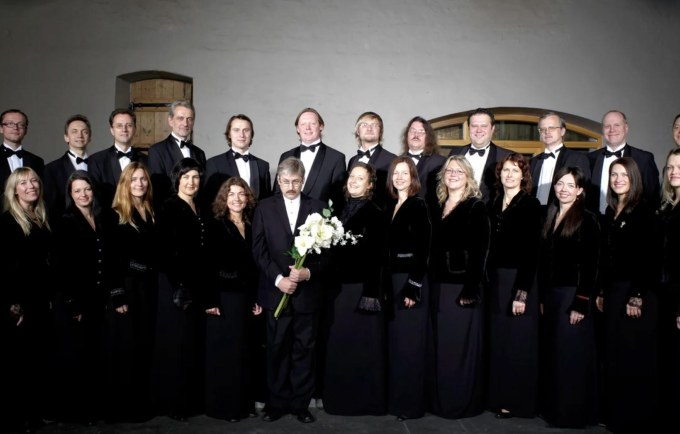
Latvian Radio Choir
Conductor Christopher Walsh-Sinka
Riga, Rīgas Svētā Alberta Romas katoļu baznīca